Not a typical request? No problem.
Get in touch

UX reviewed, UI redesigned, interfaces refreshed — all to make things easier for users and better for business.
Need to test an idea fast, without going all in?
Expect a streamlined, functional UX/UI in no time.
Visitors getting lost and dropping off?
Time to adjust user navigation logic.
Afraid a redesign could do more harm than good?
The update will be careful — what works stays untouched.
No one to take care of UX/UI design?
From UX research to clean UI mockups — we’ve got it covered.
We focus on what matters: user behavior, thoughtful structure, and data-driven improvements. Design that is measured, then proven to work.
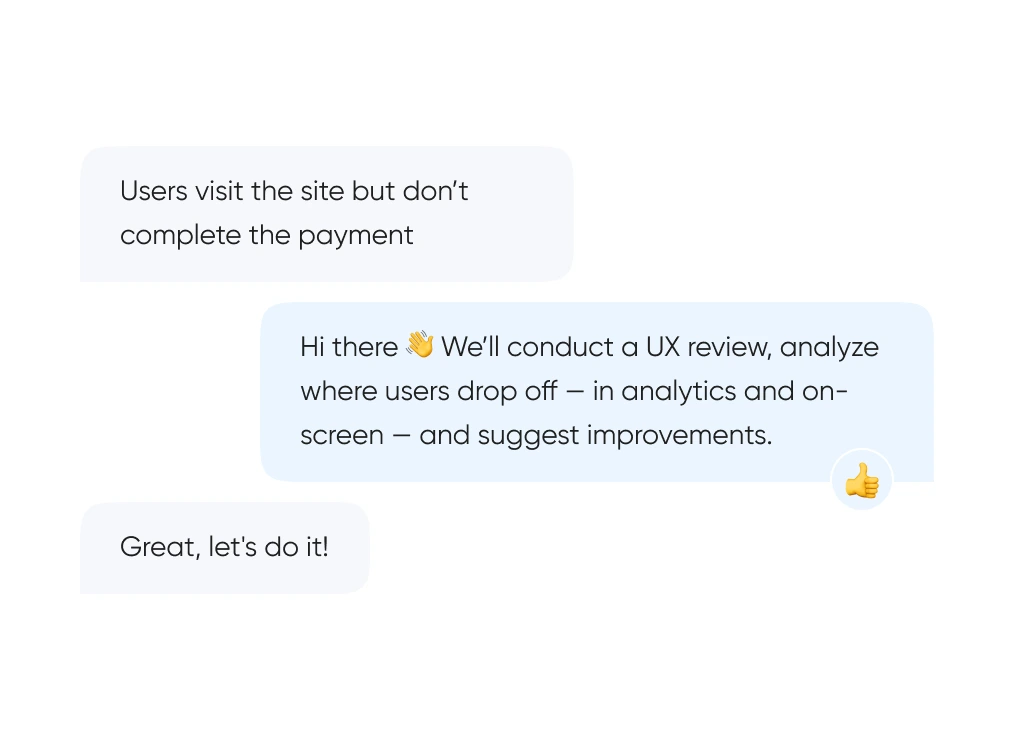
We start with real behavior: run UX reviews, analyze the full funnel, and identify exactly where and when users drop off.
We build out logic and structure — from user flows and prototypes to final layouts. Everything gets tested before it ever reaches code.
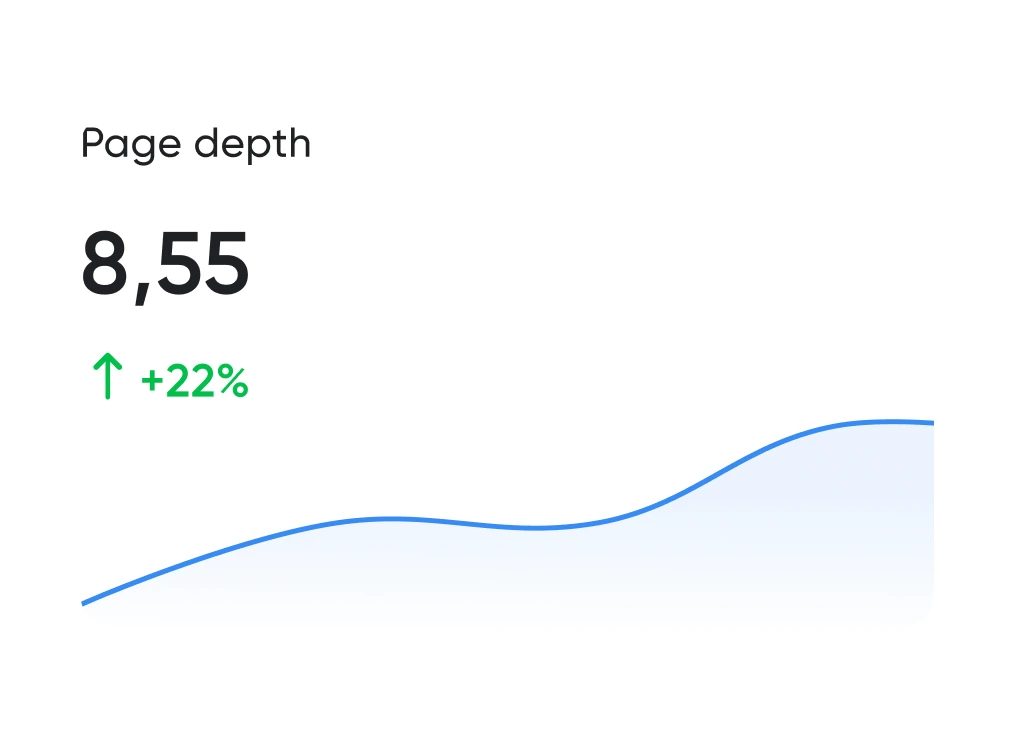
Looking good is the easy half. The work is working well. We track the numbers: time to complete key actions, scroll depth, conversion rate. All measurable.
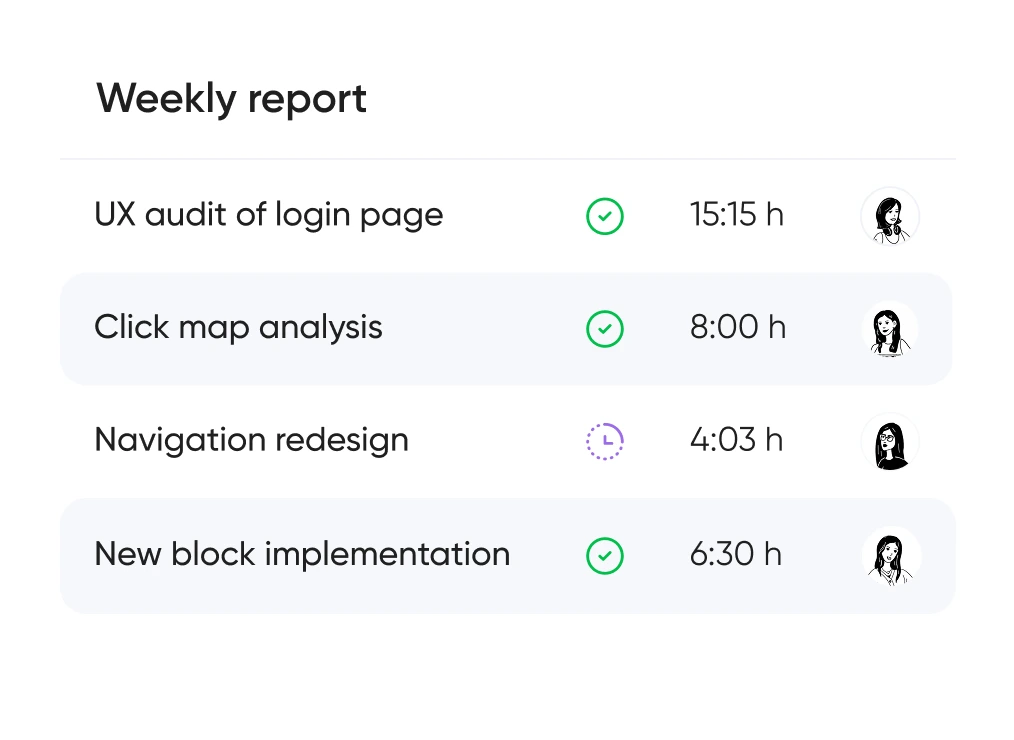
You always know which hypotheses we’re testing, what we’re improving — and why. No design for design’s sake — only what brings real business value.


Support for launching, refreshing, or rethinking an interface — at the right pace
and tailored to your product and business goals.
Pricing is tailored to each project — based on its stage, scope, and business objectives.
We use only the tools that help us create intuitive, responsive, and scalable interfaces.
UX/UI design for ecommerce, fintech, edtech, and more.
Didn’t find what you were looking for? Drop us a line at info@toimi.pro.
Cost depends on project complexity, scope, and the number of screens and user flows involved — a focused UX/UI engagement covering a core user journey, wireframes, and a polished interface design starts approximately from a few thousand dollars, while comprehensive design programs spanning multi-role platforms, extensive user research, interactive prototyping, and design system development are priced higher. The Woodlands client base includes healthcare technology companies at the Alexandria Center for Advanced Technologies campus, energy services firms near Woodloch Forest Drive building internal operational tools, and professional services companies near Hughes Landing developing client-facing platforms. Exact pricing is discussed individually after reviewing your project brief.
A focused UX/UI engagement — user flow mapping, wireframes, and polished interface design for a core feature set — typically takes 4–8 weeks. A comprehensive design program covering user research, full information architecture, interactive prototyping, usability testing, and a complete design system runs 10–18 weeks. For The Woodlands businesses with a development team standing by — an in-house engineering team or a parallel development engagement — we build the design timeline to feed handoff-ready assets into development without creating a bottleneck between design completion and build start.
Healthcare technology companies, energy services firms, professional services organizations, and SaaS founders are the most frequent clients. Healthcare technology companies at the Alexandria Center campus — building clinical workflow tools, patient-facing applications, and medical device interfaces — need UX design that reduces cognitive load for users operating under time pressure in clinical environments. Energy services firms building internal operational platforms for field and office teams need interfaces that work across device types and skill levels without extensive training. SaaS founders in The Woodlands' growing technology sector need UI design that communicates product quality to early customers and investors before the full feature set is complete.
UX design — user experience — covers the structure, logic, and flow of a product: how users navigate, what they can do, in what sequence, and how the system responds. UI design — user interface — covers the visual layer: how screens look, how interactive elements are styled, and how the brand is expressed through the interface. For a The Woodlands healthcare technology company building a clinical workflow platform, UX design determines whether a nurse can complete a documentation task in three steps or eight; UI design determines whether those steps feel polished and trustworthy. We provide both within a single engagement, with UX preceding UI so visual decisions are built on a validated structural foundation.
Yes — and for products where design decisions significantly affect task completion or conversion, research is not optional. User research methods are scaled to your project's scope and timeline: lightweight approaches like stakeholder interviews, competitive analysis, and existing analytics review for focused engagements; structured usability testing, user interviews, and journey mapping for comprehensive programs. For The Woodlands healthcare and energy clients whose end users have specific technical contexts — clinical staff, field engineers, procurement managers — research ensures the interface is designed for the actual user rather than an assumed one.
Yes. Interactive prototypes — built in Figma — allow your team, your stakeholders, and real users to navigate the designed experience before a line of code is written. For The Woodlands businesses commissioning platforms where misaligned UX assumptions would be expensive to correct in development — a multi-role client portal, a complex onboarding flow, a data-heavy dashboard — prototype testing surfaces those issues at design cost rather than development cost. Prototypes are also used for investor presentations, internal alignment sessions, and development team briefings where a static mockup doesn't communicate the intended interaction behavior clearly enough.
Discovery covers your business objectives, user profiles, technical constraints, and any existing research or analytics that inform design decisions. Design development follows in defined phases — information architecture and wireframes before visual design — with structured review sessions at each phase gate using a shared Figma workspace. For The Woodlands product teams where engineering, product management, and business stakeholders all have input into design decisions, we run phase-gate reviews that bring the right people in at the right moment rather than involving everyone in every iteration. Design handoff includes annotated specifications, component documentation, and developer-ready assets structured for your development team's preferred workflow.
Final deliverables include a complete Figma design file covering all screens, states, and interactions, an interactive prototype for the primary user flows, a design system covering components, typography, color, and spacing standards, annotated developer handoff documentation, and — where user research was conducted — a research report covering key findings and design rationale. For The Woodlands businesses moving directly into development after design completion, the handoff package is structured to minimize back-and-forth between design and engineering — reducing the interpretation overhead that accumulates when design intent isn't explicitly documented. You own all deliverables outright at project close.


