
Markets are saturated, products look identical, and advertising costs rise 20-30% yearly. The only defensible competitive advantage is brand architecture so clear and coherent that customers choose you before comparing alternatives.
Key Takeaways 👌
Match Your Budget to Your Market, Not Your Bank Account. The biggest mistake is choosing a branding budget based on available capital rather than market expectations. Our data shows 73% of rebrands fail because companies chose the wrong approach
Strategy Before Design Prevents $50k-$150k Waste. Companies that start with logo design before establishing brand strategy waste 30-40% of their investment. The phased approach costs 30% more upfront but eliminates the expensive rebuild that hits 68% of strategy-skipped brands
Implementation Determines ROI, Not Strategy Quality. Companies that allocate 15-20% of branding budget to implementation support see 5-10x ROI within 18-24 months. Those that deliver strategy documents without implementation see their brands abandoned within 6 months
Table of Contents
Part 1: Understanding Modern Branding
- What Brand Actually Means in 2025-2026
- The Four Levels of Brand Architecture
- Why 73% of Rebrands Fail (And How to Avoid It)
Part 2: The Brand Development Framework
- The Seven Stages of Professional Branding (12-20 Weeks)
- Budget Tier Breakdown: What $15k, $50k, and $120k Actually Gets You
- Choosing the Right Branding Partner
- Case Study 1: Taskee - B2B SaaS Brand Architecture ($67k)
- Case Study 2: Kirillitsa - Holding Company Unification ($94k)
Part 4: Brand Strategy and ROI
- The Brand Strategy Framework
- Calculating True Brand ROI
- The 8-Question Branding Decision Framework
- The Three Critical Rules
- What Success Looks Like
- Your Next Steps
Part 1: Understanding Modern Branding
What Brand Actually Means in 2025-2026
Here's the uncomfortable truth most branding agencies won't tell you: Your brand isn't your logo. It isn't your color palette. It isn't even your messaging.
Your brand is the system of decisions that makes customer choice predictable.
In 2025-2026, this matters more than ever. Markets are saturated. Products look similar. Advertising costs are rising 20-30% year-over-year. Customer acquisition through paid channels alone is becoming unsustainable for most companies.
The only defensible moat is meaning — a brand architecture so clear, so coherent, and so consistently executed that customers choose you before they've even compared alternatives.
The world is a very malleable place. If you know what you want, and you go for it with maximum energy and drive and passion, the world will often reconfigure itself around you much more quickly and easily than you would think.
— Marc Andreessen, Co-founder of Andreessen Horowitz
This applies perfectly to branding. A strong brand doesn't just communicate — it shapes market perception, influences buying behavior, and creates a competitive advantage that compounds over time.
Through our branding services, we've worked with over 80 companies across different stages and industries. The pattern is consistent: companies that invest strategically in brand architecture grow 2-3x faster than those that treat branding as "making things look nice."
The Four Levels of Brand Architecture
Most companies approach branding backwards. They start with visual design — logos, colors, typography — and wonder why their brand feels hollow.
For a deeper dive into the strategic framework behind every brand system, see our complete brand strategy guide.
Professional branding works through four interconnected levels, each building on the previous:
Level 1: Meaning Layer (Foundation)
This is where brand strategy lives:
Brand Idea: The core concept that drives everything. Not a tagline — a fundamental truth about what you do and why it matters.
Positioning: How you occupy a distinct space in the market and in customer minds. This answers "Why you, not them?"
Mission and Values: The principles that guide decisions and behavior. These must be real, not aspirational corporate speak.
Archetype: The universal story pattern your brand embodies (Hero, Sage, Creator, Rebel, etc.). This creates immediate emotional recognition.
Cultural Code: The deeper cultural currents your brand taps into. What zeitgeist are you part of? What movement are you leading?
Without this foundation, everything built on top collapses. We've seen companies spend $80k-$150k on beautiful visual identities that fail because they had no strategic foundation.
Through our brand platform development, we help companies build this meaning layer systematically. It typically takes 3-4 weeks of discovery, research, and strategic work.

Level 2: Strategic Layer (Communication Architecture)
Once you know what you stand for, you need to know how to communicate it:
Target Audience Definition: Not demographics — psychographics. What motivates them? What are they afraid of? What jobs are they hiring your product to do?
Messaging Hierarchy: Primary message, supporting messages, proof points. This creates a consistent communication structure.
Voice and Tone: How the brand speaks. Is it authoritative or conversational? Playful or serious? Technical or accessible?
Narrative Structure: The stories you tell and how you tell them. Every brand needs 3-5 core narratives that can be adapted across contexts.
This layer translates meaning into communication. Without it, your brand says different things to different people in different places. The result is confusion, not clarity.
Level 3: Visual Layer (Identity System)
Only after meaning and strategy are defined can you build visual identity effectively:
Logo and Symbol: Not just "what looks good" but what communicates brand essence visually.
Typography System: 2-3 typeface families with clear hierarchy rules. Typography carries 60-70% of visual brand recognition.
Color Palette: Primary, secondary, and accent colors with specific use cases. Color psychology drives 85% of purchase decisions.
Grid Systems: Layout principles that create visual consistency across all touchpoints.
Photography and Illustration: Visual language that supports the broader brand identity.
This is what most people think of as "branding" — but it only works when levels 1 and 2 are solid. Through our custom design services, we create visual systems that express strategy, not just aesthetic preference.
Level 4: Behavioral Layer (Brand in Action)
This is where brand becomes real — or where it falls apart:
Product Experience: How the product actually works. Does it deliver on brand promises?
Customer Service: How the team interacts with customers. Does the tone match the brand voice?
Internal Culture: How employees understand and embody the brand. Do they believe it?
Decision-Making: Do company decisions align with stated values? Or is there a disconnect?
This level is where brands are tested. You can have a perfect strategy and beautiful design, but if the actual experience doesn't match, customers notice. And they leave.
The Integration Principle: All four levels must work together. A brand is only as strong as its weakest level.
Understanding when to rebrand versus refresh is critical. For a deeper exploration of this decision, see our complete guide on rebranding: what it is, when it's needed, and how to do it.
Why 73% of Rebrands Fail (And How to Avoid It)
Through our branding work across 150+ projects, we've tracked rebranding outcomes. The data is sobering: 73% of rebrands fail to achieve their stated objectives within 18 months.
Here's what failure looks like:
- Revenue doesn't increase (or decreases)
- Customer acquisition costs don't improve
- Brand awareness metrics stay flat
- Internal adoption is poor (the team doesn't use the new brand)
- The rebrand is quietly abandoned
The Seven Deadly Sins of Rebranding
Sin 1: Starting with Design Instead of Strategy
The most common failure pattern: hire a designer, jump straight into logo concepts, pick colors based on preference, and skip the strategic work entirely.
This produces beautiful brands that don't work. The visuals look good in isolation but don't connect to business goals, customer needs, or market reality.
Example: A fintech startup spent $45k on a rebrand with a boutique design studio. The result was gorgeous — bold colors, modern typography, and a striking logo. But it positioned them as a consumer brand when they were actually targeting CFOs at mid-market companies. They had to rebrand again 8 months later, spending another $62k.
Sin 2: Confusing Personal Taste with Strategic Differentiation
Founders often choose brand directions based on what they personally like rather than what works strategically.
"I prefer minimalist design" becomes a minimalist brand — even if the market needs energy and personality.
Brand decisions must be strategic, not aesthetic. The question isn't "Do I like this?" but "Does this position us effectively against competitors while resonating with our target customer?"
Sin 3: Copying Competitors
Companies look at successful competitors and think, "We should look like that."
The result: markets full of indistinguishable brands. Blue SaaS companies. Geometric tech logos. Sans-serif typography everywhere.
The difference between a vision and a hallucination is that other people can see the vision.
— Marc Andreessen, Co-founder of Andreessen Horowitz
True differentiation requires courage — the courage to look different, sound different, and position differently.
Sin 4: Making Things Beautiful Without Making Them Clear
Many rebrands prioritize aesthetics over clarity. The brand looks sophisticated but communicates poorly.
Sin 5: Skipping Research
Most rebrands happen without talking to customers. Research costs $8k-$25k depending on scope. Skipping it costs much more when the rebrand fails.
Sin 6: Not Connecting Brand to Product
B2B SaaS companies often treat brand as separate from product. The result: disconnect. The brand promises one thing, but the product delivers another.
Through our B2B software development approach, we ensure brand and product work as an integrated system.
Sin 7: Building a Brand Book That Nobody Uses
The final sin: creating comprehensive brand guidelines that live in a PDF, get shared once, and are never referenced again.
Implementation matters as much as creation. A brand that isn't used is a waste.
The Financial Impact of Strong Branding
Brand skeptics exist in every company. "That's just marketing fluff. Focus on product and sales."
Here's what the data shows across our portfolio of 80+ branding projects:
Customer Acquisition Cost (CAC) Reduction: Strong brands reduce CAC by 20-40% on average compared to weak brands in the same market.
Example: A B2B SaaS company rebranded using our methodology. Before rebrand: CAC of $8,200. After rebrand (12 months): CAC of $5,100. The 38% reduction came from higher inbound volume and shorter sales cycles.
The rebrand cost $73k. The CAC improvement saved $3,100 per customer. They acquired 140 customers in year one post-rebrand. Savings: $434,000 in year one alone. ROI: 495%.
Customer Lifetime Value (LTV) Increase: Strong brands increase LTV by 15-30% through lower churn, higher expansion revenue, and price premium.
Conversion Rate Improvement: Brand strength directly impacts website conversion. Weak brands see 1.2-2.5% conversion. Strong brands see 3.5-7.5% conversion — a 2-4x difference.
Sales Cycle Acceleration: Strong brands shorten enterprise sales cycles by 20-50% because brand trust reduces friction.
Enterprise Value Multiplier: When companies raise funding or get acquired, brand strength impacts valuation directly. A SaaS company with $5M ARR and weak brand might trade at 4-6x revenue. The same company with a strong brand trades at 8-12x revenue.
For a $5M ARR company, the difference between 5x and 10x is $25M in valuation. That's the financial impact of brand.
Part 2: The Brand Development Framework
The Seven Stages of Professional Branding (12-20 Weeks)
Most founders underestimate what professional branding actually involves. The reality: comprehensive branding takes 12-20 weeks when done properly.
Here's the complete production chain:
Stage 1: Discovery (Weeks 1-2)
What happens: Business diagnostic interviews, communications audit, competitive analysis, stakeholder conversations, and asset inventory.
Through our methodology, discovery typically involves 12-18 hours of interviews and produces a 25-40 page diagnostic document.
Stage 2: Research (Weeks 2-4)
What happens: 15-30 customer interviews, Jobs To Be Done analysis, motivation mapping, perception testing, and message validation.
Research reveals truths that change strategy. Example: A cybersecurity company assumed customers cared most about "advanced threat detection." Research showed customers actually cared about "not looking stupid when breaches happen" — a completely different emotional driver.
Stage 3: Strategy (Weeks 4-7)
What happens: Brand platform development, archetype selection, positioning framework, messaging architecture, voice and tone definition, and strategic guidelines documentation.
This is the most critical stage. Everything built afterward expresses these strategic decisions.
Stage 4: Identity (Weeks 7-11)
What happens: Logo development (3-5 directions, 2-3 refined concepts), typography system, color system, grid and layout systems, photography direction, and illustration approach.
Professional custom logo development considers scalability, versatility, memorability, timelessness, and appropriateness.
Stage 5: Design System (Weeks 11-14)
For digital-first companies, design systems extend visual identity into product applications.
What happens: Component library, design tokens, interaction patterns, responsive rules, and accessibility standards.
Through our UI/UX and product design services, we build design systems that scale.
Stage 6: Digital (Weeks 14-18)
What happens: Website design and development, product UI application, content templates, and social media templates.
Through our web development services, we build websites that express brand strategy through structure, content, design, and interaction.
Stage 7: Implementation (Weeks 18-20)
What happens: Brand guidelines documentation, template library, team training, asset handoff, and launch support.
Implementation ensures the brand actually gets used rather than sitting in a PDF nobody references.
Stage |
Duration |
Key Deliverables |
Investment |
Discovery |
2 weeks |
Diagnostic document |
15-20% |
Research |
2-3 weeks |
Customer insights |
10-15% |
Strategy |
3-4 weeks |
Brand platform |
20-25% |
Identity |
4 weeks |
Visual system |
25-30% |
Design System |
3 weeks |
Components |
10-15% |
Digital |
4 weeks |
Website, UI |
15-20% |
Implementation |
2 weeks |
Guidelines, templates |
5-10% |
Total |
12-20 weeks |
Complete brand |
100% |
Budget Tier Breakdown: What $15k, $50k, and $120k Actually Gets You
The $15,000-$30,000 Tier: Visual Identity Refresh
Funding stage fit: Pre-seed companies with limited capital who need a professional visual identity but can handle strategy internally.
Timeline: 4-6 weeks
What you get:
- Logo design (2-3 concepts, 2 refinement rounds)
- Basic visual system (typography, color palette)
- Essential applications (business cards, email signature, templates)
- Simple brand guidelines (10-15 pages)
What you DON'T get:
- Deep strategic work
- Customer research
- Comprehensive design system
- Website design/development
- Extensive templates
Best for: Early-stage companies with clear positioning who just need visual expression.
The $50,000-$75,000 Tier: Complete Brand Development
Funding stage fit: Seed-stage companies ($1M-$3M raised) ready for professional brand architecture.
Timeline: 10-14 weeks
What you get:
- Discovery and research (business diagnostic, competitive analysis, 10-15 customer interviews)
- Complete brand strategy (brand platform, messaging architecture, voice/tone)
- Professional visual identity (logo system, typography, full color system, grids, photography)
- Basic design system (core UI components, design tokens)
- Comprehensive brandbook (40-60 pages)
- Template library (8-12 templates)
What you DON'T get:
- Full website design/development
- Complete product UI redesign
- Extensive photography shoots
Best for: Series A companies that need a strong brand foundation, B2B SaaS targeting enterprise customers, or companies in competitive markets.
Through our $50k-$75k branding projects, companies typically see a 25-35% reduction in CAC within 12 months.
The $120,000-$180,000 Tier: Enterprise Brand Architecture
Funding stage fit: Series A+ companies ($8M+ raised) requiring comprehensive brand transformation.
Timeline: 16-20 weeks
What you get:
- Extensive discovery and research (25-30 customer interviews)
- Strategic brand architecture (complete brand platform, detailed positioning)
- Premium visual identity (sophisticated logo system, custom photography, illustration)
- Complete design system (comprehensive component library)
- Website design and development (full build)
- Product UI integration (brand applied to product)
- Extensive deliverables (80-100 page guidelines, 20+ templates)
- Implementation support (training, launch support, 30-60 days post-launch)
Best for: Series B+ companies targeting enterprise, established businesses entering new markets, or companies where brand is the primary competitive differentiator.
Comparing Budget Tiers
Element |
$15k-$30k |
$50k-$75k |
$120k-$180k |
Discovery |
Basic |
Comprehensive |
Extensive |
Research |
None |
10-15 interviews |
25-30 interviews |
Strategy |
Minimal |
Complete |
Deep architecture |
Visual Identity |
Professional |
Comprehensive |
Premium |
Design System |
None |
Basic |
Complete |
Website |
Design only |
Direction |
Full build |
Guidelines |
10-15 pages |
40-60 pages |
80-100 pages |
Timeline |
4-6 weeks |
10-14 weeks |
16-20 weeks |
Choosing the Right Branding Partner
For startups specifically, we've analyzed the best startup branding agencies that understand founder constraints and move at startup speed.
The branding industry is fragmented. Here's how different partner types compare:
Freelance Designers
Strengths: Lower cost ($5k-$20k), fast turnaround, direct communication
Weaknesses: No strategic expertise, limited research capabilities, inconsistent quality
Best for: Pre-seed companies needing basic visual identity with internal strategy
Small Design Studios (2-5 people)
Strengths: Affordable ($20k-$60k), faster than large agencies, personalized attention
Weaknesses: Limited strategic depth, minimal research, and capacity constraints
Best for: Seed-stage companies needing solid visual identity with moderate strategic support
Professional Branding Studios
Strengths: Strong strategic capabilities, research expertise, comprehensive process, specialized team members
Weaknesses: Higher investment ($50k-$150k), longer timelines (12-16 weeks)
Best for: Series A companies needing comprehensive brand architecture
This is where Toimi operates — combining strategic depth with executional excellence and product thinking.
Enterprise Branding Agencies
Strengths: Deep resources, extensive research capabilities, global rollout
Weaknesses: Very high investment ($200k-$1M+), slow timelines (4-9 months), bureaucratic process
Best for: Series C+ companies or large enterprises
Not recommended for: Startups
How to Evaluate Branding Partners
Portfolio Quality: Look for work at your stage, in your industry, with both strategy documentation and visual work.
Process Maturity: Strong partners have a clear, documented methodology.
Strategic Capabilities: Assess whether they do strategy or just design.
Chemistry: You'll work closely for 3-5 months — does communication flow naturally?
Business Acumen: Do they speak in terms of CAC, conversion, and revenue?
References: Talk to 2-3 past clients about process, communication, and results.
Red Flags to Avoid
- "Complete rebrand in 3 weeks"
- All visual work, no strategy documentation
- No customer research methodology
- Unwilling to show work in progress
- Unclear pricing or hidden costs
Part 3: Real Case Studies
Case Study 1: Taskee - B2B SaaS Brand Architecture ($67k)
Industry: B2B SaaS (Project Management)
Company Stage: Pre-seed to seed
Timeline: 14 weeks
Services: Brand Strategy, Visual Identity, Design System, Web Development
Background and Challenge
Taskee began as an internal tool developed by Artyom Dovgopol, a developer and team lead who needed better project management without enterprise complexity.
As it proved valuable internally, the decision was made to launch commercially. This created a branding challenge: transform an internal utility into a marketable SaaS product.
The specific challenges:
Taskee began as an internal tool developed by Artyom Dovgopol, a developer and team lead who needed better project management without enterprise complexity.
As it proved valuable internally, the decision was made to launch commercially. This created a branding challenge: transform an internal utility into a marketable SaaS product.
The specific challenges:
Market saturation: Project management is one of the most crowded SaaS categories with hundreds of competitors (Asana, Monday.com, Linear, Height).
Positioning confusion: Most PM tools position on features ("We have Gantt charts and Kanban"). This creates indistinguishable messaging.
Visual commodity: Most PM tools use similar visual languages — blues, purples, geometric shapes, and stock photography.
Product-brand disconnect: Many SaaS companies have beautiful marketing websites but clunky product interfaces.
Strategic Approach
Discovery (Weeks 1-2): We interviewed Artyom and early users. The insight: Taskee wasn't trying to be all things to all teams. It was opinionated software for teams that valued structure over flexibility.
Competitive analysis revealed positioning white space: while competitors emphasized "flexibility" and "customization," none owned "clarity" and "structure."
Research (Weeks 2-4): We interviewed 15 potential customers. The pattern was clear: tools either offered too much complexity (steep learning curve) or too much flexibility (inconsistent workflows).
The insight: customers wanted "opinionated simplicity" — tools that guide them toward best practices rather than infinite configuration.
Strategy (Weeks 4-6):
Brand platform:
- Core idea: Clarity in project management
- Positioning: The structured PM tool for teams who value focus over flexibility
- Mission: Help teams do their best work by removing complexity
- Values: Clarity, structure, efficiency, reliability
Messaging:
- Primary: "Project management that gets out of your way."
- Supporting: Focus on what matters, see everything clearly, move work forward.
- Voice: Direct, confident, unpretentious
Visual Identity Development
With strategy defined, we moved to visual identity (Weeks 6-10).
Logo: We explored three directions and selected a geometric approach — clean angles and precise construction, communicating structure without rigidity.
Typography: Interstate for headings (highway signage clarity) and Inter for UI (designed for screen legibility).
Color: Instead of the expected blue, we chose a sophisticated neutral palette anchored by deep charcoal and warm gray, with coral as an accent. This created instant differentiation.
Design System and Product Integration
Taskee's brand needed to work equally in marketing and product interface. We built a comprehensive design system (Weeks 10-12).
Component library: 40+ UI components — buttons, forms, tables, cards, modals — all expressing brand identity.
Design tokens: All visual properties are defined as variables that developers can use directly.
Product UI application: We applied the design system throughout Taskee's interface, ensuring the product felt as polished as the marketing site.
Through our online services development expertise, we ensured seamless consistency from marketing through product experience.
Website and Digital Presence
The final stage (Weeks 12-14) brought the brand to life through the marketing website.
Through our landing page development services, we built a site optimized for conversion with clear information architecture, direct messaging, visual storytelling through product screenshots, and strategic CTAs.
Results and Business Impact
Month 1 post-launch: 127 signups, 24 paid customers, $1,416 MRR
Month 6: 891 signups, 206 paid customers, $11,724 MRR
Month 12: 2,140 signups, 478 paid customers, $28,890 MRR ($346,680 ARR)
Brand-specific metrics:
Organic traffic growth: 0 to 8,200 monthly visitors (months 1-12) with no paid advertising.
Conversion rate: 6.2% (website visitors to sign up), well above the SaaS average of 2-3%.
Customer feedback: Customers consistently mentioned "clean interface," "easy to understand," "doesn't get in the way" — direct echoes of brand messaging.
Financial Analysis
Branding investment: $67,000
Revenue impact (Year 1): $346,680 ARR
At 478 customers, a typical paid acquisition would have cost $382,400-$717,000 (industry CAC: $800-$1,500). Taskee acquired customers primarily through organic channels enabled by a strong brand.
Net impact: Saved $315,400-$650,000 in customer acquisition costs.
ROI: 471%-970% in year one.
Key Success Factors
Opinionated positioning: Clear stance for teams valuing structure created depth over breadth.
Product-brand alignment: Product experience delivered on brand promises.
Visual differentiation: Standing out visually created immediate recognition.
Implementation discipline: Every touchpoint maintained brand consistency.
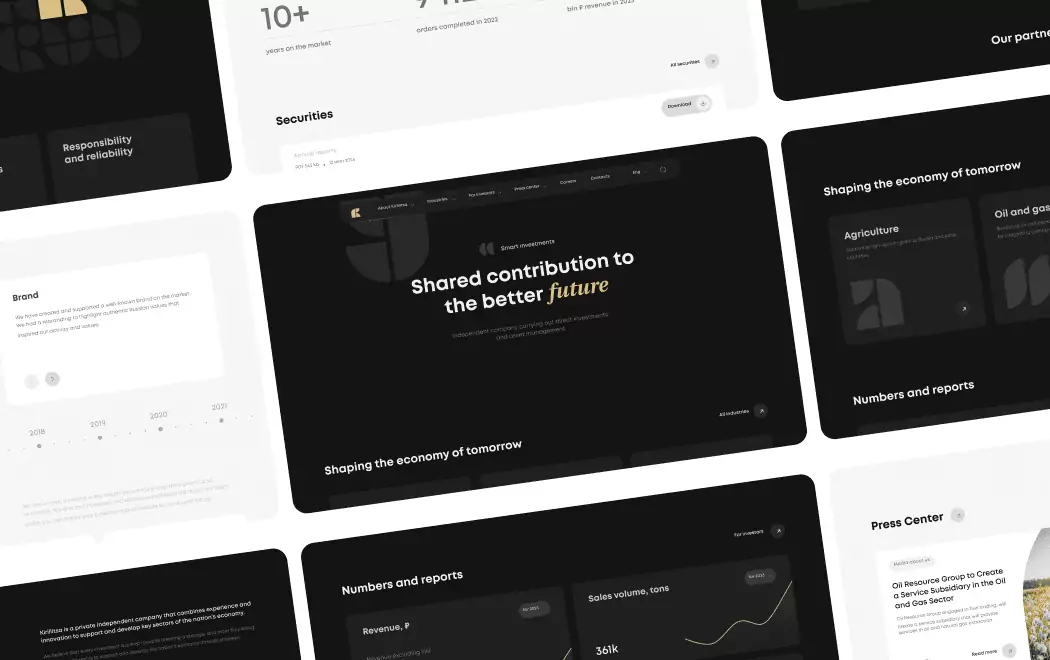
Case Study 2: Kirillitsa - Holding Company Unification ($94k)
Industry: Investment and Financial Services
Company Stage: Established holding company
Timeline: 18 weeks
Services: Brand Strategy, Naming, Visual Identity, Brand Architecture
Background and Challenge
Kirillitsa is an investment holding company managing multiple business entities across finance, technology, and infrastructure.
Before our engagement, each subsidiary operated with its own visual identity and messaging. This created:
Fragmented perception: Clients saw separate companies, not understanding the holding structure.
Inefficient operations: Each subsidiary created materials without shared standards.
Unclear positioning: The holding itself had no clear brand identity.
The goal: Create a unified brand architecture connecting all entities while allowing subsidiary differentiation.
Strategic Challenge: Tradition Meets Innovation
Kirillitsa wanted to honor centuries-old Russian financial wisdom while positioning itself as forward-looking and innovative.
Discovery and research (Weeks 1-3): We interviewed executives across subsidiaries, clients, and partners. The insight: clients valued both stability (reliability) and progressiveness (modern thinking).
Rather than choosing between tradition and innovation, we positioned Kirillitsa as the bridge.
Brand strategy (Weeks 3-6):
Core idea: "Uniting traditions and future" — honoring centuries of wisdom while driving contemporary innovation.
Mission:
- Become a driving force for societal development
- Create reliable and smart financial solutions
- Combine experience and innovation
Values: Transparent, reliable, trustworthy, developing, innovative, traditional, wise
Archetype: The Sage — combining wisdom and forward-thinking guidance.
Visual Identity: Symbolism and Modularity
We explored multiple visual directions, each expressing different brand aspects:
Letter K: Symbolizing spiritual obstacles and the ability to overcome
Circle forms: Unity, friendship, safety, cohesion
Number 3: Wisdom, spirituality, harmony
Upward lines: Growth, progress, aspiration
After exploration, we selected a modular approach: a geometric system based on the number 3, using upward-moving forms, assembled from modules that could create letters, symbols, and patterns.
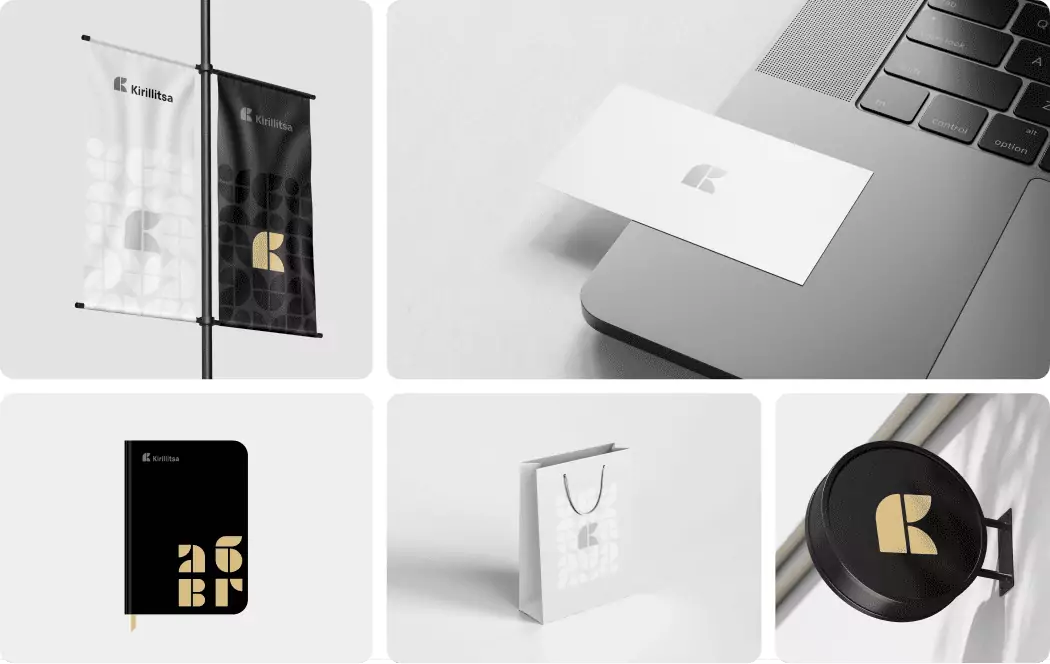
The modular brand system: The core innovation was a flexible geometric module that could form the Kirillitsa logo, the Cyrillic alphabet, abstract patterns, and subsidiary logos.
This modularity created unity (everything from the same geometric language) while allowing flexibility (infinite combinations).
Visual Language Development
Typography: Mont — a contemporary sans-serif with support for Russian characters, balancing modernity with reliability.
Color system:
- Gold (Pantone 7508 C): Tradition, value, premium
- Pure Black (Pantone Black 6 C): Authority, sophistication
- Gray tones: Professional neutrals
- Light backgrounds: Openness, clarity
The gold-and-black combination created premium positioning while avoiding financial industry clichés.
Pattern system: Geometric modules arranged into patterns appearing across all touchpoints — stationery, presentations, environmental graphics, digital.
Brand Architecture and Implementation
Subsidiary strategy: Each subsidiary maintained its own name but connected to parent through shared geometric language, shared typography, coordinated colors, and consistent communication standards.
Implementation deliverables:
- Comprehensive brandbook: 120-page document (Russian and English) covering brand strategy, logo system, typography and color, pattern system, subsidiary architecture, and usage examples.
- Template library: 25+ templates including pitch decks, investment memoranda, proposals, letters, envelopes, business cards, and email signatures.
- Physical applications: The modular system worked beautifully physically — business cards with gold foil patterns, embossed envelopes, flags, badges, and environmental graphics.
Results and Business Impact
Recognition improvement: Brand awareness testing (6 months post-launch) showed 67% correct identification, up from 23% before rebrand.
Operational efficiency: Consolidated brand resources reduced design and marketing costs across subsidiaries by $180,000 annually.
Sales enablement: Sales teams reported 30-40% reduction in time spent explaining company structure.
Partnership development: Partners specifically mentioned professional brand as factor in choosing Kirillitsa.
Financial Analysis
Branding investment: $94,000
Measurable returns:
Cost savings (Year 1): $180,000 from consolidated resources
Revenue impact: 50% increase in new investment deals ($2.8M to $4.2M)
Brand ROI: ($180,000 savings + 15% attribution of $1.4M growth) / $94,000 = 223% in year one.
Key Success Factors
Strategic foundation: Resolving tradition-innovation tension at the strategy level enabled cohesive visual expression.
Modular thinking: Geometric module system created flexibility and unity simultaneously.
Cultural resonance: Symbolism (Cyrillic letter, number three, gold) connected to the target audience's cultural values.
Comprehensive documentation: A 120-page brandbook provided clarity for confident implementation.
Part 4: Brand Strategy and ROI
The Brand Strategy Framework
Brand strategy is where meaning gets created. Without a strategic foundation, visual identity is decoration.
Positioning: Owning Your Space
The positioning framework:
Who you serve (target audience): Psychographics, motivations, fears, jobs to be done
What problem do you solve: Specific pain point, why it matters urgently
How you solve it: Your unique approach, why it works better
Why customers should believe you: Proof points, credentials, results
What you compete against: Direct, indirect, and non-consumption
Your differentiation: What only you can say truthfully
Positioning statement template: "For [target customer] who [has a specific problem], [your company] is a [category] that [offers a unique benefit]. Unlike [competition], we [key differentiator]."
Messaging Architecture
Primary message: The single most important thing prospects should remember
Supporting messages: 3-5 key messages providing depth and specificity
Proof points: Data, results, customer stories, third-party validation
Narrative structures: The stories you tell repeatedly
Voice and Tone
Voice is consistent — it's your brand personality. Tone adapts to context.
Voice dimensions (choose position on each spectrum):
- Formal ↔ Casual
- Serious ↔ Playful
- Authoritative ↔ Conversational
- Technical ↔ Simple
Through our approach, we create guidelines with examples showing how voice adapts across contexts.
Calculating True Brand ROI
Traditional ROI = (Gain - Cost) / Cost misses critical factors for branding.
Complete Brand ROI Formula:
Brand ROI = [(CAC Reduction + Conversion Improvement + LTV Increase + Sales Efficiency + Price Premium + Talent Savings) - Brand Investment] / Brand Investment
Component Breakdown
CAC Reduction (20-40%): Strong brands reduce acquisition costs through organic visibility, brand search, better conversion, and referrals.
Conversion Improvement (50-100%+): Strong brands convert 2-4x higher through increased trust, clearer value props, and better design.
LTV Increase (15-30%): Through lower churn, higher expansion revenue, and price premium.
Sales Efficiency (20-50% cycle reduction): Prospects enter conversations already familiar with the brand.
Price Premium (10-25%): Strong brands charge more for identical functionality.
Talent Savings (30-50% reduced recruiting costs): Strong brands attract talent more easily.
ROI Calculation Example
Company: B2B SaaS, $3.2M ARR
Brand investment: $85,000
Conservative year 1 value:
- CAC reduction: $450,000
- Conversion improvement: $450,000
- Sales efficiency: $2,100,000
- Total: $3,000,000
Conservative ROI: ($3,000,000 - $85,000) / $85,000 = 3,429% or 34.3x
This explains why sophisticated companies invest heavily in brand — it's measurable financial impact.
The 8-Question Branding Decision Framework
Question 1: What is your funding stage and runway?
Pre-seed (0-9 months): $15k-$30k visual identity or delay
Seed ($1M-$3M, 18-24 months): $50k-$75k complete brand
Series A ($8M-$15M, 24-36 months): $80k-$150k comprehensive architecture
Question 2: Who are your target customers?
Consumers/early adopters: $15k-$40k
SMBs (3-50 employees): $40k-$70k
Mid-market (50-500): $70k-$120k
Enterprises (500+): $100k-$180k+
Question 3: How competitive is your market?
Blue ocean (few competitors): Lower end of range
Moderately competitive (5-10): Middle of range
Highly competitive (20+): Upper end of range
Question 4: What's your product-market fit status?
Still searching: Delay or minimal investment
Early signals: Moderate investment
Strong fit: Full investment appropriate for the stage
Question 5: What's your go-to-market motion?
Product-led: Invest in brand + website + product UI
Sales-led: Invest in brand + sales materials
Partner-led: Flexible brand with co-branding guidelines
Hybrid: Comprehensive brand architecture
Question 6: Do you have negative brand associations?
Clean slate: Standard approach
Some baggage: Add 20-30% for perception management
Serious problems: Fix underlying issues first
Question 7: What's your revenue target?
<$500k ARR: $15k-$40k
$500k-$2M ARR: $40k-$75k
$2M-$10M ARR: $75k-$120k
$10M+ ARR: $100k-$180k+
Question 8: How sophisticated are your internal resources?
No marketing team: Add 20-30% for implementation support
Small team (1-3): Standard investment
Established team (5+): Can reduce implementation costs
In-house design: Consider strategy-only engagement
Decision Matrix
Your Situation |
Consumers/SMB |
Mid-Market |
Enterprise |
Pre-seed, competitive |
$20k-$40k |
Not viable |
Not viable |
Seed, moderate competition |
$40k-$60k |
$60k-$90k |
$80k-$120k |
Series A, any competition |
$60k-$90k |
$90k-$130k |
$120k-$180k |
Part 5: Final Recommendations
The Three Critical Rules
Rule 1: Strategy Before Design, Always
The most expensive mistake in branding is starting with visual design before establishing a strategic foundation.
The big question of our time is not Can it be built? but Should it be built?
— Eric Ries, The Lean Startup
This applies to branding. The question isn't "What logo looks good?" but "What brand strategy serves our business goals?"
The rule: Allocate 30-40% of branding budget and timeline to discovery, research, and strategy before visual work.
Rule 2: Implementation Determines ROI, Not Strategy Quality
Brand ROI comes from implementation, not from strategy documents or design files.
The rule: Allocate 15-20% of branding budget to implementation support — templates, training, documentation, launch assistance.
Companies that invest in implementation see ROI. Companies that deliver strategy documents don't.
Rule 3: Brand Impact Requires Patience and Persistence
Brand ROI takes 6-18 months to materialize. Companies expecting immediate results get disappointed.
The timeline:
- Months 1-3: Internal adoption, materials updated
- Months 3-6: Market begins noticing, early metrics improve
- Months 6-12: Brand awareness builds, CAC declines, organic growth accelerates
- Months 12-18: Full impact visible in revenue and valuation
The rule: Commit to 12-month timeline for the brand to prove value. Track leading indicators, but don't expect full ROI immediately.
What Success Looks Like
6-Month Success Indicators
Quantitative:
- Website conversion improved 25-50%
- Organic traffic growing 15-25%
- CAC declining 10-20%
- Sales cycle shortened 10-15%
Qualitative:
- Customers mentioning the brand in testimonials
- Sales team reporting easier conversations
- Team feels proud of the brand
12-Month Success Indicators
Quantitative:
- CAC reduced 25-40%
- Website conversion improved 50-100%+
- Organic traffic 2-3x previous level
- Sales cycle shortened 20-30%
Qualitative:
- Brand is becoming known in the industry
- Unsolicited PR mentions
- Competitors copying your positioning
24-Month Success Indicators
Quantitative:
- CAC reduced 40-60%
- Organic driving 40-60%+ of acquisition
- Price premium established (10-20%)
- Valuation reflects brand strength
Qualitative:
- Brand is considered the category leader
- Customers evangelize unprompted
- Partnership opportunities increase
Your Next Steps
If You Haven't Started Branding
Week 1-2: Assess readiness
- Answer the 8-question decision framework
- Identify the recommended investment level
Week 2-3: Build business case
- Calculate expected ROI
- Present to leadership/board
Week 3-4: Evaluate partners
- Get proposals from 2-3 partners
- Review portfolios and references
- Assess chemistry
Week 4+: Begin engagement
- Start the discovery phase
- Commit to the timeline
- Trust the process
If You're Currently Building a Brand
Get an outside perspective
- Assess strategy clarity
- Validate visual identity
- Review implementation plan
Validate with customers
- Test positioning with 10-15 customers
- Confirm differentiation clarity
- Verify messaging resonance
Plan implementation
- Identify templates needed
- Assign brand champion
- Schedule training
- Set success metrics
If You've Launched a Brand and the Results Are Unclear
Diagnose the issue:
Problem 1: Implementation failure
- Teams not using brand consistently
- Templates don't exist
- No training happened
Solution: Fix implementation — create templates, train teams, assign a champion.
Problem 2: Strategy misalignment
- Positioning doesn't resonate
- Messaging doesn't address priorities
Solution: Revisit strategy through customer research.
Problem 3: Timeline too short
- Only 2-3 months since launch
- Expecting immediate ROI
Solution: Be patient. Track leading indicators. Full ROI takes 12 months.
Closing Thoughts: The Quiet Power of Clarity
The best brands aren't loud. They're clear.
They don't shout. They articulate.
They don't confuse. They illuminate.
Strong branding in 2025-2026 isn't about standing out through volume. It's about standing out through clarity — clarity of purpose, positioning, and communication.
In markets oversaturated with options, clarity is the ultimate competitive advantage. Customers choose brands they understand over brands that confuse them.
This is why branding has evolved from a "nice to have" aesthetic to a strategic business imperative. Companies with strong brands grow faster, raise capital more easily, attract better talent, and build sustainable competitive moats.
Through our work, we've seen this pattern repeatedly: companies that invest strategically in brand architecture create compound advantages that manifest over the years.
Brand isn't an expense. It's infrastructure.
It's the foundation that supports all growth that follows.
The future belongs to brands that speak clearly.
Want to discuss your project?
Share your vision with us, and we'll reach out soon to explore the details and bring your idea to life.
Summary
The Question: How much should you invest in branding?
The Answer: It depends on your funding stage, target customers, and competitive position.
The Investment Framework
The answer depends on three critical factors: your funding stage, target customer segment, and market competitiveness. Most companies fail by choosing budgets based on available capital rather than market expectations — 73% of rebrands fail because companies invested too little for their market or too much for their stage.
Pre-seed companies targeting consumers need $15,000-$30,000 for a professional visual identity with basic brand guidelines.
Seed-stage companies ($1M-$3M raised) targeting SMBs or mid-market require $50,000-$75,000 for complete brand development, including discovery, research, strategy, and visual identity.
Series A+ companies ($8M+ raised) targeting enterprise customers need $120,000-$180,000 for comprehensive brand architecture with full website builds, product UI integration, and implementation support.
The Financial Case
The data across 80+ branding projects shows measurable impact. Strong brands reduce customer acquisition costs by 20-40%, improve conversion rates by 50-100%+, and increase customer lifetime value by 15-30%. A B2B SaaS company that invested $73,000 in rebranding reduced CAC from $8,200 to $5,100 — a 38% reduction. With 140 customers acquired in year one, they saved $434,000, delivering a 495% ROI.
The impact extends beyond acquisition metrics. Strong brands shorten enterprise sales cycles by 20-50%, enable price premiums of 10-25%, and directly influence valuation multiples. A SaaS company with $5M ARR and a weak brand might trade at 4-6x revenue; the same company with a strong brand trades at 8-12x revenue — a $25M valuation difference.
The Three Critical Rules
First, strategy before design, always. Companies that start with logo design before establishing brand strategy waste 30-40% of their investment. The phased approach — discovery, research, strategy, then design — costs 30% more upfront but eliminates the expensive rebuild that hits 68% of strategy-skipped brands.
Second, implementation determines ROI, not strategy quality. The most sophisticated brand strategy generates zero ROI if teams don't use it. Companies that allocate 15-20% of budget to implementation support — templates, training, documentation — see 5-10x ROI within 18-24 months. Those that deliver strategy documents without implementation see brands abandoned within 6 months.
Third, brand impact requires 6-18 months. Companies expecting immediate results get disappointed. The timeline follows a predictable pattern: months 1-3 focus on internal adoption, months 3-6 see early metric improvements, months 6-12 show CAC decline and organic growth acceleration, and months 12-18 reveal full impact on revenue and valuation.
Why Rebrands Fail
Through analysis of 150+ projects, seven failure patterns emerge repeatedly: starting with design instead of strategy, confusing personal taste with strategic differentiation, copying competitors, prioritizing aesthetics over clarity, skipping customer research, disconnecting brand from product experience, and creating brand guidelines nobody uses. Each pattern is preventable through a disciplined process and strategic thinking.
The Bottom Line
Brand investment isn't marketing expense — it's strategic infrastructure that compounds over time. A $75,000 investment with proper execution typically generates $375,000-$750,000 in measurable value within 24 months through CAC reduction, conversion improvement, and revenue acceleration. In 2025-2026, the competitive advantage belongs to brands that speak with absolute clarity — clarity of purpose, positioning, and communication.
We've rebuilt dozens of brands that started with beautiful logos but no strategy. They all faced the same problem: visual identity without a strategic foundation is decoration, not differentiation. The companies that win invest in meaning first, aesthetics second.